


















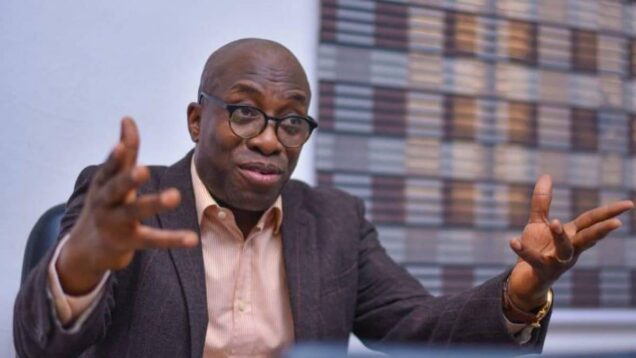
In a recent, high-stakes virtual town hall The Forensics Politics, Segun Sowunmi—the outspoken PDP chieftain and veteran political strategist—did not mince words. Known for his oratorical prowess and deep intellectual grounding, Sowunmi’s voice rose above the digital fray to deliver a message that was equal parts warning and call to action. For the stakeholders of the Nigerian project, his message was clear: The era of “strategic laziness” must end if the nation is to be rescued.

Sowunmi’s analysis of the current administration provides a nuanced perspective that departs from standard partisan rhetoric. He acknowledged that many of President Bola Tinubu’s foundational reforms are, in fact, working and hold the potential to stabilize the long-term economy. However, he identified a critical disconnect between these policy successes and the public’s perception, placing the blame squarely on the shoulders of the President’s communication team. He argued that the administration is currently hampered by spokespeople who often seem more interested in combative engagement than in effectively articulating the “why” and “how” of the government’s complex economic shifts. This failure to build a relatable narrative means that while the “engine” of the reform might be running, the passengers feel only the bumps in the road, leading to a dangerous deficit of trust.

This gap in communication creates a fertile ground for the 2027 power struggle, where Sowunmi scrutinized the roles of Peter Obi and Atiku Abubakar. He cautioned that while Peter Obi has successfully galvanized a youth-driven movement, his refusal to integrate with established national party structures like the PDP represents a strategic “bypass” that may struggle to secure the necessary spread across all 774 local governments. Turning his gaze to Atiku, Sowunmi recognized him as a titan of the game but maintained that Atiku’s future relevance depends entirely on whether he can transform from a candidate into a unifier who can pull a fragmented opposition together. Without this synergy, the opposition remains trapped in a state of strategic laziness, essentially handing a victory to the incumbent by default.

Central to this discourse is Sowunmi’s passionate advocacy for a South East presidency, which he framed as a moral and structural necessity for the federation. He argued that an Igbo Presidency is not a matter of political charity but a fundamental act of justice required to heal the nation’s deep-seated divisions. He insisted that Nigeria cannot achieve true stability while consistently barring a significant part of the family from the head of the table. By ensuring equity and allowing the South East a fair shot at leadership, Sowunmi believes the country would see a natural evaporation of the tensions that currently threaten national cohesion.

The pathway forward, according to Sowunmi, requires an urgent transition to what he calls “narrative infrastructure.” This involves moving beyond the cult of personality and focusing on a residency-based model of inclusion, where a citizen’s political rights and contributions are tied to where they live and pay taxes rather than their ancestral origins.

He concluded with the sobering reminder that Nigeria is far too complex for trial and error, and the margin for mismanagement has completely evaporated. The challenge for 2027 is to build a consensus that favors national survival over personal ego, ensuring that the reforms of today are not lost to the communication failures of the present.