























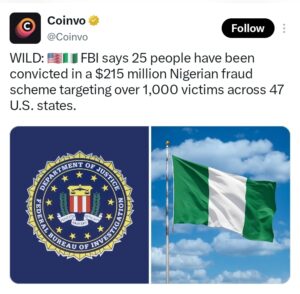
In a move that has sparked widespread backlash on social media, the X account @Coinvo framed the conviction of 25 defendants in a major fraud case as a “$215 million Nigerian fraud scheme,” prominently featuring both U.S. and Nigerian flags in its post. Critics, including many Nigerian users and commentators, accused the account of selective and misleading reporting that unfairly attributes an international criminal enterprise primarily to Nigeria.

According to the official announcement from the United States Attorney’s Office for the Northern District of Ohio, the correct description is far more nuanced: “25 Defendants Convicted in International $215M Scam That Targeted 1,000+ Victims.” The case involved a sophisticated business email compromise (BEC) and email hacking ring that defrauded over 1,000 victims of approximately $215 million across 47 U.S. states and 19 countries.

A federal jury in Toledo, Ohio, convicted three defendants after a four-day trial — Oluwafemi Michael Awoyemi (40, Romeoville, Illinois), Aruan Drake (37, Atlanta, Georgia), and Peter Reed (35, Oak Forest, Illinois) — on wire fraud conspiracy charges. Twenty-two other defendants pleaded guilty to wire fraud conspiracy and money laundering conspiracy. Authorities seized about $1.2 million in assets, including cryptocurrency, cash, luxury watches, and real estate.

While some defendants have Nigerian connections and reports indicate at least nine Nigerians were among those convicted, the majority of participants were U.S.-based individuals, including American citizens. The operation was a transnational network relying on actors, financial infrastructure, and victims primarily within the United States — not a scheme orchestrated from or representative of Nigeria as a nation.

Stakeholders and observers have condemned the original framing for potentially reinforcing negative stereotypes. “This is an international crime involving multiple nationalities, many of them U.S. citizens living in America,” several commentators noted, urging media outlets to adopt precise, evidence-based language when covering cross-border cybercrime. Nigeria has no monopoly on such schemes, just as the U.S. has no monopoly on their victims or facilitators. The episode serves as a reminder for all stakeholders in the information ecosystem — journalists, digital platforms, and the public — to prioritize accuracy and context over sensational headlines, especially on issues that impact national reputation and international perceptions. As global cyber threats evolve, balanced reporting that avoids nationality-based scapegoating is essential for constructive dialogue and effective international cooperation against fraud.

Stakeholders Magazine will continue to monitor developments in this case and advocate for responsible media practices that serve the public interest.