






















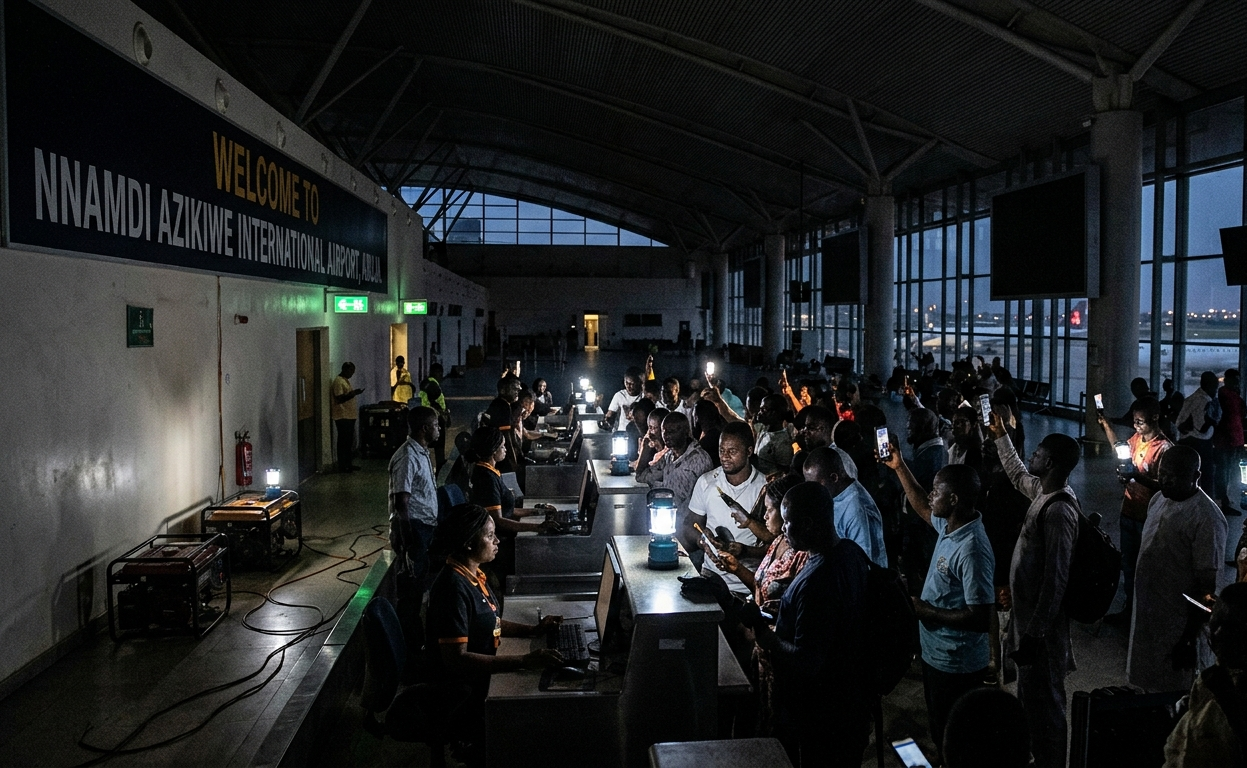
The Nnamdi Azikiwe International Airport in Abuja is more than a transit hub; it is the diplomatic front door to Africa’s most populous nation. Yet, on a Tuesday that will be remembered for all the wrong reasons, that door slammed shut in total darkness. As the national grid faltered, the terminal was transformed into a cavernous hall of shadows where travelers navigated by the flickering blue light of their smartphones. This was not merely a mechanical failure; it was a high-profile symptom of a chronic energy fever that has gripped Nigeria for decades.

The sudden silence of the air conditioning and the freezing of digital check-in screens at a “priority” facility highlighted a jarring reality. While airports are theoretically protected by multiple layers of redundancy, the failure in Abuja exposed a breakdown in the transition between the national grid and local backup systems. It served as a viral, visible embarrassment that echoed the frustrations millions of Nigerians face in their homes and businesses every single day.

The Paradox of an Energy Giant
Nigeria’s electricity struggle is a masterclass in irony. The nation sits atop the largest natural gas reserves in Africa and possesses vast hydroelectric potential through its major river systems. Despite this wealth of raw energy, the country’s power generation frequently hovers between a meager 4,000 and 5,000 megawatts. To put that in perspective, a single medium-sized European city often consumes more power than is currently distributed to over 200 million Nigerians. This gap between potential and reality is the result of a “starved” infrastructure that has been neglected for generations.

A Fragile Web of Wires
The frequent “national grid collapses” that plunge the entire country into darkness are often the result of a fragile, radial network. Unlike a mesh grid that can reroute power when one section fails, Nigeria’s transmission lines act like a single, brittle thread. When gas supplies to thermal plants are interrupted by pipeline issues, or when aging transformers at key substations explode under pressure, the entire system can cascade into failure. This fragility is compounded by a liquidity crisis within the privatized sector. Since the 2013 unbundling of the state power company, the distribution companies have struggled with debt and poor collection rates, leaving little capital to replace equipment that was installed during the mid-20th century.

The Cost of the “Generator Economy”
The economic fallout of this darkness is staggering. In the absence of a reliable public utility, Nigeria has devolved into the world’s largest “generator economy.” From massive industrial plants to small neighborhood barbershops, billions of dollars are spent annually on imported petrol and diesel to keep the lights on. This “generator tax” makes Nigerian-made goods more expensive than imports, stifling local industry and draining the foreign exchange reserves of the nation. It is a cycle of inefficiency where the solution—private generation—is actually a barrier to long-term national prosperity.

Toward a De-centralized Future
There is, however, a slow shift toward a new architecture of energy. The recent Electricity Act of 2023 represents a fundamental change in the law, finally allowing state governments and private entities to generate, transmit, and distribute their own power. This breaks the federal monopoly and opens the door for “embedded generation” and regional mini-grids. By moving away from a single, temperamental national grid and toward a localized, diversified system, Nigeria hopes to ensure that the next time a breaker trips in the capital, the lights at the gateway stay on. For a nation that dreams of industrial leadership, the path to the future must be illuminated by more than just the glow of a phone screen.