



















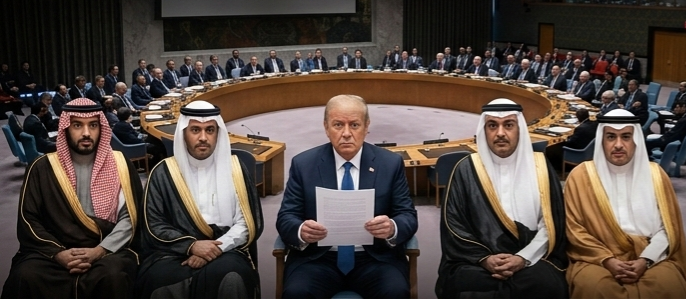
In the wake of the February 28 salvo, the halls of the United Nations in New York have become a second front. While the military outcome was a failure for Tehran, the diplomatic fallout is being expertly harvested by Riyadh and Abu Dhabi. For the first time in history, the Gulf states are not just spectators to a US-Iran confrontation—they are the lead plaintiffs.

1. The Death of “Strategic De-escalation”
For years, the Gulf’s mantra was de-escalation at all costs. The 2023 Saudi-Iran rapprochement and Qatar’s constant mediation were the pillars of this “Patience Doctrine.” This morning, that doctrine was officially buried. In an unprecedented joint diplomatic offensive, Saudi Arabia, the UAE, Bahrain, Qatar, Kuwait, and Jordan are preparing a unified submission to the UN Security Council (UNSC). Their argument is simple: Iran’s retaliation did not target the aggressors; it targeted the neutrals. By firing at five sovereign Arab nations, Tehran has functionally declared the “Good Neighbor” policy null and void.

2. The Emergency Session: 4:00 PM EST
An emergency UNSC meeting has been called for this afternoon, requested by France and Bahrain. This is a pivotal shift. Typically, such requests come from the P5 (Permanent Members). Having Bahrain—the host of the US 5th Fleet—as a primary petitioner shifts the narrative from “Great Power War” to “Regional Defense Against Rogue Aggression.”

The Gulf’s Three Key Demands:
* A “No-Fly Zone” for IRGC Assets: Riyadh is expected to lobby for an international mandate to intercept any IRGC-linked craft over civilian airspace.
* Sovereignty Sanctions: A push for a new tier of sanctions specifically targeting the IRGC’s ballistic missile command as a “transnational terrorist threat” to sovereign states.
* The “Joint Defense” Precedent: The UAE and Saudi Arabia are discussing a formalization of the “Middle East Air Defense Alliance” (MEAD), seeking UN recognition of their right to collective self-defense.

3. The Fragile Saudi-Emirati Pivot
While the region stands unified against Iran, internal dynamics are shifting. Recent friction over Somaliland and the Red Sea had cooled relations between Crown Prince Mohammed bin Salman and President Sheikh Mohamed bin Zayed.

However, today’s telephone summit between the two leaders suggests a “Crisis Reset.” The Kingdom has pledged “all possible support” to the UAE, signaling that when the missiles fly, the Saudi-Emirati security bond remains the bedrock of regional stability.
“Riyadh is not just defending its borders; it is auditioning for the role of the region’s ultimate security guarantor.”
 The Stakeholder Outlook: A Post-Tehran Order
The most significant diplomatic maneuver isn’t what is being said—it’s what isn’t. Notably, the Gulf states have refrained from condemning the initial Israeli/US strike. By focusing their outrage exclusively on Iran’s “indiscriminate retaliation,” they are signaling a quiet acceptance of a post-IRGC reality.
The next 48 hours at the UN will determine if the world sees this as a “cycle of violence” or the “final containment” of a regime that has run out of friends.