













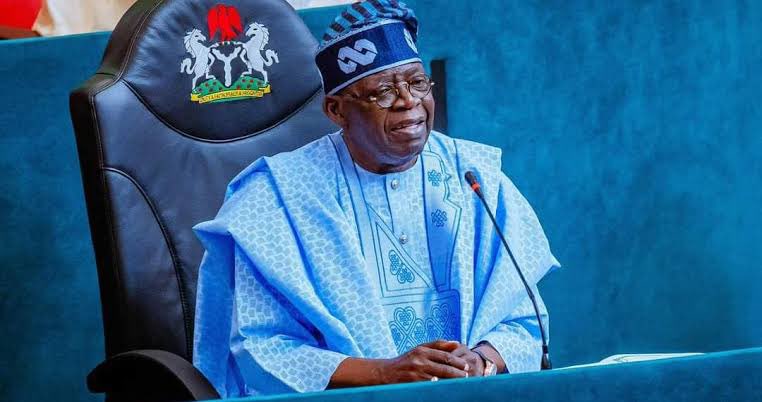
Banners are going up. Pundits are sharpening their pens. The country is doing what it does best, which is to argue, loudly, about its own future. Today is Thursday, 8 October 2026, and it is exactly one hundred days until Saturday, 16 January 2027, when Nigerians choose a president. I have read the brief, weighed the evidence and reached a verdict. They will return President Bola Ahmed Tinubu, GCFR, to office, and they will do it convincingly.


Start with what he inherited. In May 2023 he took the oath over an economy held together by habit and hope. A fuel subsidy was swallowing public money by the trillion. A multiple exchange-rate regime was rewarding the well-connected. The dollar buffers were thin. Everyone knew it could not last. Every previous government blinked. This one did not. Within days it removed the subsidy and moved to unify the rate. You may hate what followed. Plenty of people did. You cannot deny the courage. Voters have long memories for the leader who did the hard thing.
Ask any trader in any market in the country and they will tell you the prices still bite. Ask them whether the worst is behind us, and watch how many nod.
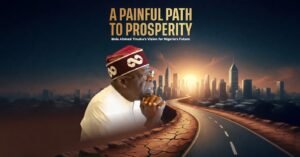
Exhibit A: the cushion
Members of the great jury of the Nigerian electorate — the only court that matters on election day — I lay before you the nation’s foreign reserves. They stood at $45.57 billion on 2 January. By 24 September they had reached $54.86 billion. That is a gain of $9.29 billion in nine months, more than seven times what was added in the same period of 2025, and the highest level since December 2008. A generation of Nigerians has never seen the country this well cushioned.
Fitch had projected, in April, that reserves would fall to about $47 billion by year-end. They went the other way, and now sit $3.82 billion above the Central Bank’s own target. Foreign capital inflows in the first quarter reached $10.37 billion, up 83.8 per cent on the year before. Investors do not put that kind of money into a country they think is drifting. They are voting with their dollars. I invite this jury to take the hint.

Exhibit B: a seat for every zone
For decades every corner of the federation has said the same thing: my region is neglected. A people-oriented president answered with institutions. With assent to the South-West and South-South Development Commission bills, all six geopolitical zones now have dedicated development commissions, joining the North-West and South-East bodies signed into law in July 2024. Each zone has its own vehicle for roads, jobs and enterprise. No region can say it was left to beg at the centre’s door.
Critics call the commissions bloat, or campaign machinery in disguise, a waste and a drainpipe ahead of 2027. That is easy to say. The governing boards and management teams have been formally inaugurated, and the Vice President has told them plainly that they will be judged on delivery, not existence. Every new institution invites suspicion in its first days, including some that critics now defend as the old order. The commissions will be tested on results. This jury will see those results before polling day.

Exhibit C: the work on the ground
Following the Supreme Court ruling, the 774 local governments now receive their allocations directly from source, bypassing the governors, and are responsible for managing the funds on behalf of the people they serve. NELFUND has paid out over ₦372 billion and carried more than 1.6 million students through higher institutions. The ₦70,000 minimum wage is signed into law.
Over 2,700 kilometres of road are under way, led by the Lagos–Calabar Coastal Highway and the Abuja–Kaduna–Kano Expressway, along with rail and gas pipelines. Old tax laws that confused citizens and scared off investors have been simplified. The state police bills are before the legislature and moving fast. Security and intelligence cooperation with the United States and other partners is stronger than it has been in years.
The other side’s best arguments
A good advocate does not hide from them. The first is the cost of living, and I will not insult this jury by pretending households have not felt the squeeze. Look at the figures with care, though. Headline inflation eased to 15.39 per cent in August 2026, against 23.14 per cent a year earlier. Core inflation fell to 13.29 per cent from 22.93 per cent, and food inflation dropped to 19.57 per cent from 25.30 per cent. Prices are still a bit higher than anyone would like. They are rising far more slowly than last year. Voters judge the direction as much as the level.
Then there is the politics. Elections are won in the arithmetic of coalitions, and President Tinubu is among the most formidable political organisers this country has produced. He builds networks, mentors governors and assembles winning alliances when the odds say otherwise. The All Progressives Congress enters this contest with incumbency and reach in every zone. The opposition is still fighting over trivialities and rivalries it has yet to settle. In a country this large, unity of purpose beats any slogan.
An election is a choice between real options, not a programme of criticism. When a family is halfway through repairing its house, with the foundation reinforced and the roof going on, it does not dismiss the builder for a stranger holding photographs of other people’s houses.
The family abroad
Nor should anyone forget Nigerians who live beyond our borders but carry the country in their hearts. From London to Atlanta, from Toronto to Dubai, the diaspora has been among the most loyal backers of this reform journey. Steady remittance inflows have helped strengthen the nation’s external position, so the family in Agege, Enugu or Kano and the cousin on a night shift abroad are holding up the same national project. Our networks are vast, our associations organised, and when the call to mobilise comes, our energy and reach will be second to none.
The elders say, however long the night, the dawn will break. For many households and businesses the night has been long. But the dawn is visible now: in the forex reserves, in falling inflation, in stronger macroeconomic dynamics, in improved security, in zero-interest education loans, in tax exemption for low-income earners, in the roads and pipelines, in the fiscal restructuring, and in development commissions taking their seats across all six zones.
So, members of the great jury, I rest my case. The record shows boldness where others hesitated, reserves at an eighteen-year high, inflation on a downward path, and six regions each holding a seat at the development table. A hundred days from now this jury will be asked whether the work should continue. I believe it will answer in a voice that leaves no room for doubt, and that January will be remembered as the month the people it was meant to serve revalidated the Renewed Hope Agenda.