





















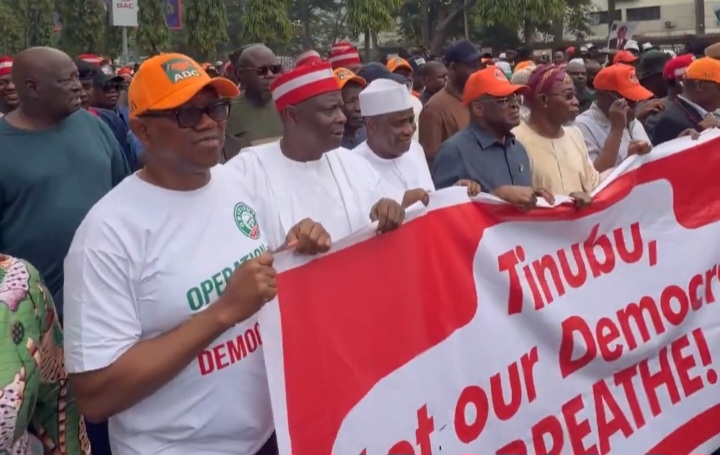
Abuja, April 8, 2026 – Nigeria’s political temperature soared Wednesday as leaders of the African Democratic Congress (ADC) and a broad coalition of opposition figures descended on the capital in a high-stakes protest tagged #OccupyINEC.Thousands of demonstrators, including youths from the Obidient Movement and ADC supporters, converged at the ADC national secretariat in Maitama before marching toward the Independent National Electoral Commission (INEC) headquarters on Zambezi Crescent. Heavy security presence, including police and military personnel, ringed the electoral body’s office, but the protest remained largely peaceful amid chants of “Our Vote Must Count,” “INEC Chairman Must Go,” and “Tinubu Must Go.”

The immediate trigger is INEC’s recent decision to remove Senator David Mark and Ogbeni Rauf Aregbesola from its official portal as National Chairman and National Secretary of the ADC respectively. The commission cited a Court of Appeal ruling and the need to maintain the status quo pending the resolution of a leadership tussle in the party. Opposition leaders have described the move as unconstitutional interference aimed at weakening a potential formidable challenge to the ruling All Progressives Congress (APC) ahead of the 2027 general elections.

Prominent figures spotted at the protest and related press events included former Vice President Atiku Abubakar, Labour Party’s Peter Obi, New Nigeria Peoples Party’s Rabiu Kwankwaso, former Senate President David Mark, ex-Transportation Minister Rotimi Amaechi, and fiery activist Dino Melaye. Their presence lent significant weight to the demonstration, drawing crowds and media attention.Addressing supporters earlier, ADC leaders issued a three-day ultimatum to INEC: restore Mark and Aregbesola, issue a public apology for what they termed “partisan behaviour,” and respect the autonomy of political parties. Failure to comply, they warned, would trigger sustained nationwide civic action, including occupations of INEC offices across the 36 states and the FCT.

National Youth Leader of the ADC, Balarabe Rufa’i, declared: “This is a fight for the soul of our democracy. We will not allow any institution to turn Nigeria into a one-party state.”Civil society voices have been divided. While some groups expressed worry over the potential for escalation, the Obidient Movement and other opposition-aligned organisations have thrown their full weight behind the protest, framing it as a broader defence of multi-party democracy and credible elections.

A counter-demonstration by the Concerned Nigeria Youth Forum days earlier had backed INEC’s stance, highlighting the polarised nature of the crisis. Meanwhile, security was visibly beefed up around key government installations in Abuja, with reports of armoured vehicles and joint security teams deployed.As the occupation continued into the afternoon, live streams and the trending #OccupyINEC hashtag amplified the message far beyond the capital. Protesters sat in organised groups near INEC, refusing to disperse, while vendors moved through the crowd supplying water and refreshments.

Stakeholders across the political spectrum are watching closely. For investors, analysts, and democracy watchers, the unfolding events raise critical questions about political stability, the independence of electoral institutions, and the prospects for a truly competitive 2027 electoral cycle. Whether INEC yields to the demands or stands firm, one thing is clear: the opposition has drawn a bold line in the sand. The coming days may determine if this protest becomes a fleeting headline or the spark for a sustained national movement.

Stakeholders Magazine will continue to monitor developments and provide in-depth analysis for Nigeria’s business and policy community.