



















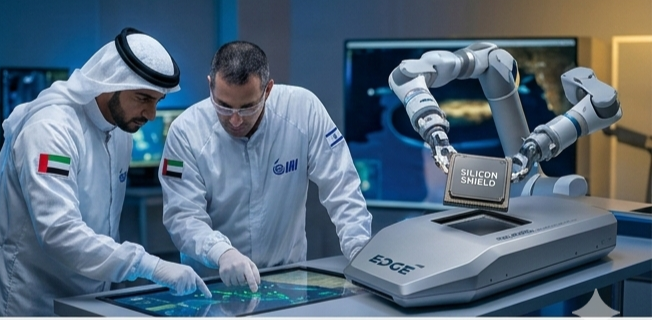
While the physical missiles of the February 28 salvo were largely defeated by kinetic interceptors, the true defensive victory is being won in the digital “grey zone.” For months, a quiet but profound technological integration has been underway—a phenomenon analysts are calling the “Silicon Shield.” This is no longer just about buying hardware; it is about a shared, AI-driven neural network that makes traditional borders obsolete.

1. The Pax Silica Alliance: A New Economic Blueprint
In January 2026, just weeks before today’s escalation, the UAE and Qatar officially joined the “Pax Silica” agreement—a U.S.-backed strategic framework that includes Israel, Japan, and South Korea.
This move signaled a fundamental shift from a hydrocarbon-based economy to one built on AI sovereignty and semiconductor supply chains.
* The “Digital Embassy” Concept: Led by Emirati AI giant G42, the region is deploying “Greenshield” sovereign cloud models. This allows for AI-driven defense data to be processed with sub-60ms latency, ensuring that if a missile launches in Isfahan, the response in Abu Dhabi is calculated in milliseconds by a shared regional algorithm.
* The Sovereign Cloud: The UAE recently launched the world’s first AI-powered sovereign financial cloud. Today, as the missiles flew, this infrastructure kept the Dubai and Abu Dhabi markets online and shielded from the massive cyber-offensive that typically accompanies Iranian kinetic strikes.

2. The Edge-IAI Synergy: Countering the Drone Swarm
The “Silicon Shield” is most visible in the partnership between the UAE’s EDGE Group and Israel Aerospace Industries (IAI).
* The $2.3 Billion Elbit Deal: Intelligence suggests that the UAE was the “undisclosed customer” behind a massive $2.3 billion deal for Elbit Systems’ J-MUSIC—a laser-based directional infrared countermeasure. This is why the Iranian missiles, despite their numbers, failed to hit high-value civil or military aviation targets.
* AI-Optical Detection: EDGE Group’s recent 30% stake in Israel’s Thirdeye Systems has brought AI-powered electro-optical sensors to the Gulf. These systems don’t just “see” incoming drones; they classify them, predict their flight paths via machine learning, and coordinate “soft-kill” electronic jamming before the human operator even sees a blip on the radar.

3. Joint Unmanned Maritime Defense
The threat to the Strait of Hormuz is being countered by the “170 M” USV program—a fleet of modular, unmanned surface vessels jointly designed by Abu Dhabi Ship Building and IAI.
* Autonomous Patrols: These vessels are currently deploying in a “mesh network” across the Strait. They are programmed to detect submarine activity and mine-laying operations without risking a single sailor’s life.

The Stakeholder Takeaway: Security as a Service
The “Silicon Shield” has effectively turned regional security into a high-tech utility. For global investors, this means the “Middle East Risk” is being mitigated by the world’s most advanced predictive AI.
“Iran is fighting a 20th-century war of attrition. The Gulf and Israel are defending with a 21st-century algorithm.”

The coalition formed this morning is not just one of shared blood and borders—it is a coalition of shared code. In the post-Feb 28 world, the most powerful weapon in the Middle East isn’t a missile; it’s the data that renders that missile useless.