



















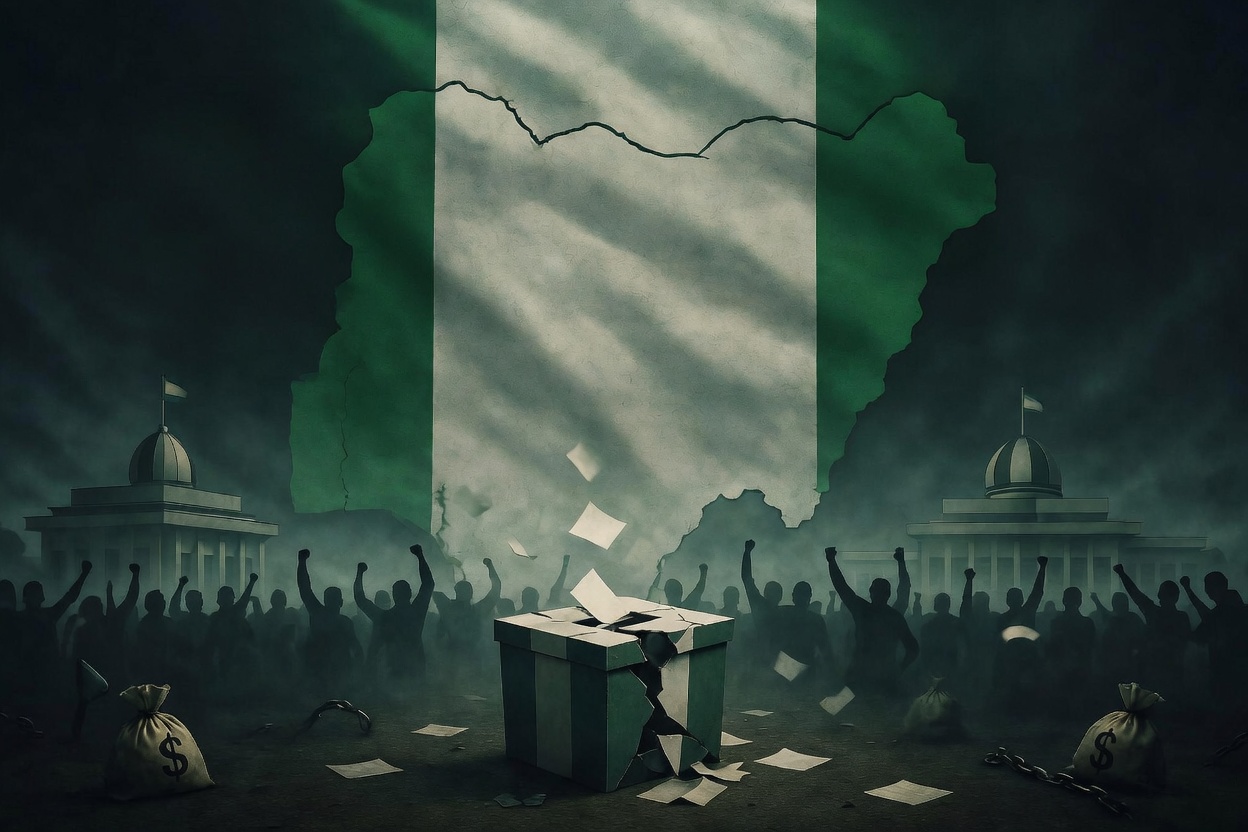
Twenty-seven years after the military handed over power in 1999, Nigerians are asking a question that once seemed unthinkable: has democracy failed us? The Fourth Republic has survived coups, disputed elections, and economic shocks. Yet for millions, it feels less like self-rule than a sophisticated form of elite capture. The question is not whether ballots are cast— they are—but whether this system still serves the people it claims to empower. The honest answer, after nearly three decades, is that Nigerian democracy has largely failed to deliver the dividends its citizens were promised.

Look at the numbers. Freedom House’s 2025 and 2026 reports rate Nigeria “Partly Free” with a stagnant score of 44 out of 100. The Economist Intelligence Unit’s Democracy Index places us in the “hybrid regime” category at 4.16 out of 10—better than military rule, but far from genuine democracy. The Bertelsmann Transformation Index 2026 notes that while 70 percent of Nigerians still prefer democracy to any other system, satisfaction has plummeted and trust in the Independent National Electoral Commission (INEC) has collapsed. The 2023 general elections and 2025 off-cycle polls exposed the rot: allegations of vote-buying, technological failures, and judicial outcomes that strained public faith. Off-cycle governorship races in 2025 once again showed how state resources are weaponized to maintain power. Youth protesters gathered at INEC headquarters in early 2026, not because they reject democracy, but because they see it being strangled by the very institutions meant to protect it. Economically, the failure is even starker. Nigeria’s oil wealth has funded a political class that treats public office as a business. Corruption Perception Index rankings remain dismal (140 out of 180 in 2024). Fuel subsidy removal and naira floatation under President Bola Tinubu were necessary reforms, yet they unleashed inflation, hunger, and hardship without visible safety nets or productivity gains. Insecurity—Boko Haram and ISWAP in the northeast, banditry in the northwest, separatist violence in the southeast—has displaced millions and turned farming communities into ghost towns. Investors cite corruption and violence as top barriers. This is not the prosperity democracy was supposed to unlock. Political parties, meant to be vehicles for ideas, are mere special-purpose vehicles for power. Defections are routine and consequence-free. Ideology is absent; loyalty is to godfathers and ethnic blocs. The result is a deformed democracy—multiparty in name, increasingly one-party dominant in practice. Scholars now speak of “federated autocracy,” where authoritarian habits are decentralized across federal, state, and local levels. Yet it would be dishonest to declare democracy dead. No tanks have rolled into Aso Rock. The military has repeatedly affirmed civilian supremacy. Civil society, though harassed, still speaks.

The press, however constrained, exposes scandals. Compared with the 1980s and 1990s, Nigerians enjoy greater freedom to criticize leaders openly. The endurance of the Fourth Republic itself is an achievement few predicted in 1999.The deeper problem is not the absence of democracy but its capture. Politics in Nigeria remains prebendal—public office is seen as a ticket to private wealth. Elections are expensive auctions funded by state resources or private godfathers. The judiciary, while occasionally courageous, is too often compromised. Federal character has become a formula for sharing spoils rather than building competence. The result is governance that responds to patronage networks, not citizens’ needs. This failure carries real risks. Public disillusionment breeds apathy or, worse, nostalgia for strongman rule. A 2025 poll on an alleged coup plot showed how quickly frustration can turn dangerous. With 2027 elections already shaping political realignments, the window for reform is narrowing. If the political class continues to treat democracy as a ritual for legitimizing elite rotation, the system will either collapse under its contradictions or mutate into something uglier.

Democracy has not failed Nigeria because the concept is flawed. It has failed because we have refused the hard work of building the supporting pillars: independent institutions, rule of law, transparent party financing, credible electoral technology, and—most crucially—a political culture that values competence over connections. True federalism that devolves real power and resources to states and local governments would reduce the stakes of capturing Abuja. Electoral reforms that make INEC genuinely autonomous and technologically robust are overdue. Genuine anti-corruption efforts, not selective prosecutions, must replace the current theatre.

Stakeholders—business leaders, civil society, the diaspora, and reform-minded politicians—must stop waiting for the system to self-correct. Democracy is not self-sustaining; it requires constant defense. The alternative is not military rule, which Nigerians rightly reject, but a slow slide into irrelevance where elections become expensive ceremonies that change nothing.

After 27 years, Nigerians do not need another lecture on the virtues of democracy. They need proof that it can work for them—through security in their farms, jobs for their children, and leaders who fear the ballot more than they fear losing patronage. Until that proof arrives, the question “Has democracy failed Nigeria?” will remain not just rhetorical, but painfully relevant. The answer, for now, is yes—in practice if not yet in name. The coming years will decide whether we can still change it.