






















While the military focus remains on the precision of Israel’s “Operation Roaring Lion” and the scattered wreckage of Iran’s retaliation, the global markets are currently calculating a far more expensive reality. Iran has just weaponized the world’s most sensitive energy corridor.
 As of this afternoon, the Strait of Hormuz—the transit point for 25% of all seaborne oil and 20% of the world’s Liquefied Natural Gas (LNG)—is effectively a “no-go” zone for commercial shipping.
1. The Closure of the Strait: A Supply Chain Freeze
Within hours of the strikes, the Iranian Revolutionary Guard Corps (IRGC) began broadcasting VHF radio warnings on Channel 16, declaring the Strait of Hormuz closed. While the UK Maritime Trade Operations (UKMTO) notes these broadcasts are not legally binding under international law, the market has already reacted as if they are.
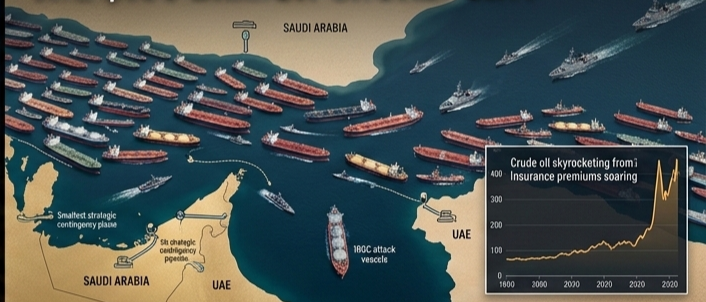
* Shipping Paralysis: Bloomberg tracking data shows tankers piling up on both sides of the entrance. Major shipping lines have suspended deliveries, including at least three Qatari LNG carriers that have paused mid-voyage.
* The Insurance Spike: Lloyd’s List reports that war risk insurance premiums, already elevated at 0.5% of hull value, are expected to increase “manyfold.” For a Very Large Crude Carrier (VLCC), this translates to hundreds of thousands of dollars in additional costs per single voyage.
2. The Energy Shock: Monday Morning Projections
Global energy markets were closed for the weekend during the strikes, but analysts are bracing for a “Sunday Night Shock” when Asian markets open.

| Metric | Friday Close (Feb 27) | Monday Projection (Mar 2) |
| Brent Crude | $72.87 / bbl | $85.00 – $92.00+ |
| Dutch TTF Gas | €42.00 / MWh | €90.00+ |
| US Gas Prices | $2.95 / gal | $3.50+ |

The China Factor: Beijing is currently the most exposed global player. China purchases 80% of Iran’s oil exports (roughly 3 million barrels per day). If the Israeli strikes on Kharg Island (Iran’s primary export terminal) are as extensive as satellite imagery suggests, China’s energy security just suffered its most significant hit in a decade.

3. Regional Resilience vs. Global Volatility
Despite the chaos, the Gulf states have been preparing for this “Black Swan” event.
* Contingency Pipelines: Both Saudi Arabia and the UAE possess pipelines capable of rerouting a portion of their exports to the Red Sea and the Gulf of Oman, bypassing Hormuz. However, these cannot absorb the full 20 million barrels per day that typically flow through the Strait.
* Fiscal Buffer: Analysts at Goldman Sachs note that while a $10 oil spike helps GCC budgets in the short term, the long-term risk to non-oil growth (tourism in Dubai, tech in Riyadh) far outweighs a temporary price windfall.

The Bottom Line for Stakeholders
The “Geopolitical Risk Premium” is no longer a theoretical line item; it is now the primary driver of global inflation. Iran’s inability to hit military targets has forced them to target the global wallet.
If the Strait remains closed for more than 72 hours, we are looking at a structural shift in global trade routes. Ships are already being advised to reroute via the Cape of Good Hope, adding 15–20 days to transit times for Europe and the US.